System Goal: Give players additional motivation to constantly improve by taking on player created challenges.
This project was created for Junior year’s Game Systems and Experience Design class. The concept behind this project was to create a system that would constantly challenge players to improve and offer players worthwhile rewards for their accomplishments. Essentially, this idea revolves around the concept of players, rather than developers, creating achievements and challenges for other players to attempt. Initially designed as a social interaction system, this project also aims to act as an additional channel for players to unite and connect through. The full system can be viewed below.
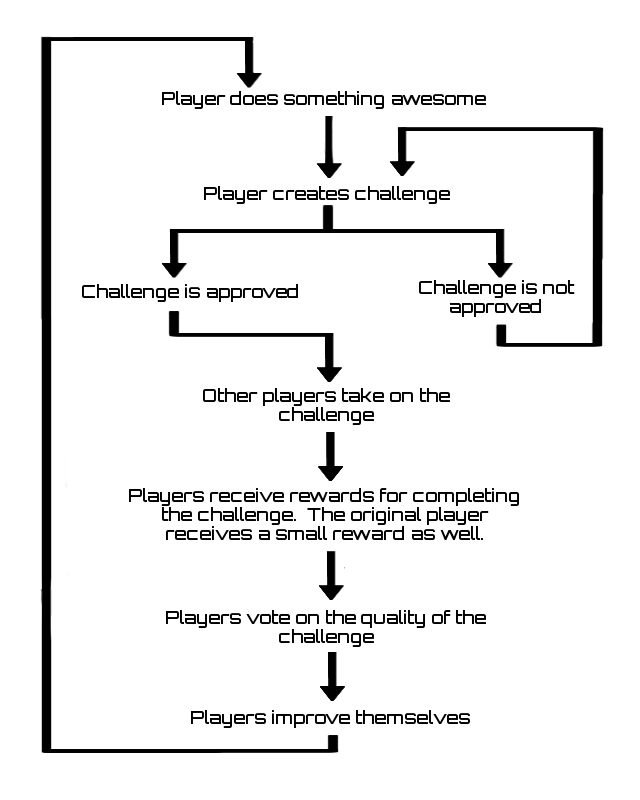
System Flow
Game System Demo
Step 1: By looking through their variety of tracked, in game stats, a player discovers they have once defeated a six enemies using only a freshly caught trout, and decides to make an achievement for such an act.
Step 2: The player fills out an in-game application detailing the requirements for completion of the achievement, and assigns the reward as three gold.
Step 3: The achievement is then reviewed by the developing company, who decide whether or not the achievement is worthwhile and fun at a basic level.
Step 4: If approved, the achievement is then released into the game, and any player is able to view the challenge, its rewards, and its rating. If not approved, the challenge application may be sent back to the original player with suggestions or explanation of rejection.
Step 5: Upon completion of the challenge, players are granted its reward, and the player who originally created the challenge is likewise granted a small reward–for example, a very small percentage of the challenge’s reward, or a simple static predetermined incentive. Players also gain an icon in their achievements tab, detailing either their completion of the achievement, or its creation.
Step 6: The community then votes on the quality of the challenge, granting it a traditional review-style rating. Additionally, votes by players who have completed the challenge influence its rewards.
History and Intent
The replayability, or retention, of games have historically been dictated largely by their genre, as well as the extent of their single and multiplayer offerings. For many games, once the majority of the content has been explored, there is often little to keep the player engaged, unless the player has their own personal attachment or goal. The advent of achievements, however, aided in prolonging the life of games, as gamers were given goals to be completed, even after the majority of the content has been explored. However, once all the achievements have been completed, there is, yet again, little to keep the player engaged. Furthermore, many games which feature achievements offer little in the way of reward, such as the Xbox’s Gamerscore, decreasing the incentive for the player to go out of their way to accomplish the achievement. As such, the goal of this experiment is to create a system which allows for a constant influx of achievements and goals for the player to choose from, while at the same time offering worthwhile rewards for taking part in the system.
Description
This system could have a variety of manifestations, depending on how the developing company chooses to implement the feature. Regardless, it begins with a player creating an achievement, or challenge, which they themselves have already accomplished. The player then fills out an application an in game application detailing the requirements of the achievement and its rewards, which is then reviewed by the developing company. If the achievement is approved it is uploaded to the game, at which point any player perusing through the greater list of challenges may choose to act on the achievement as a personal goal. When a player completes a challenge, they are granted its reward, and the player who originally created the achievement is granted either a very small static reward, or a very small percentage of the challenge’s reward–if applicable.
The community then votes on the quality of the achievement, across possible criteria such as uniqueness, difficulty, and overall quality. The resultant rating grants the challenge a traditional rating–e.g. 3 out of 5 stars–then influences the reward received by the player who created the challenge, and eventually, at certain thresholds, the reward granted to players who complete the challenge. The intended experience is to create a feeling of constant growth. Players should feel they always have a goal to strive towards, something that will improve them, make them a better player. Even casual players, by taking achievements structured towards their style of play, should feel a sense of achievement and growth.
Post Mortem
Of those questioned, overall reception appeared to be positive. Offering both a psychological reward–achievement–as well as a physical reward–currency–seemed to also result in favorable interest. When asked what kind of achievements one might like to see or create, answers ran the gamut from “Kill 100 of x enemy” and “Play for x hours” to “Defeat x within y amount of time using only z.” As such, it seems likely that some of the first created achievements would be ones that are fairly standard within current games–care must be taken, then, to assure the system does not become stagnated by legacy achievements simply requiring great amounts of logged time, or vast amounts of kills on a specific enemy. The nature of the game and community will likely be the best indicators of which achievements do and don’t fit into the system. [3]
Bibliography
Beggy, Jason, Mia Consalvo. “Achievements, Motivations and Rewards in Faunasphere.” The International Journal of Computer Game Research 11.1 (2011). Game Studies. Web. 22 Nov. 2011.
Fergusson, Michael. “Achievements, Social Games and Virtual Goods.” ayogo.com. Social Game Design, 22 Mar. 2010. Web. 22 Nov. 2011.
Irwin, Mary Jane. “Unlocking Achievements: Rewarding Skill With Player Incentives.” Gamasutra.com. Gamasutra, 1 Apr. 2009. Web. 22 Nov. 2011.
Rees, Dianne. “Achievements in Learning: What We Learn from Games.” instructionaldesignfusions.com. Instructional Design Fusions, 19 May 2011. Web. 22 Nov. 2011

 Jacob Mott