System Goal: Merge turn based tactical combat with real-time strategic unit control and movement.
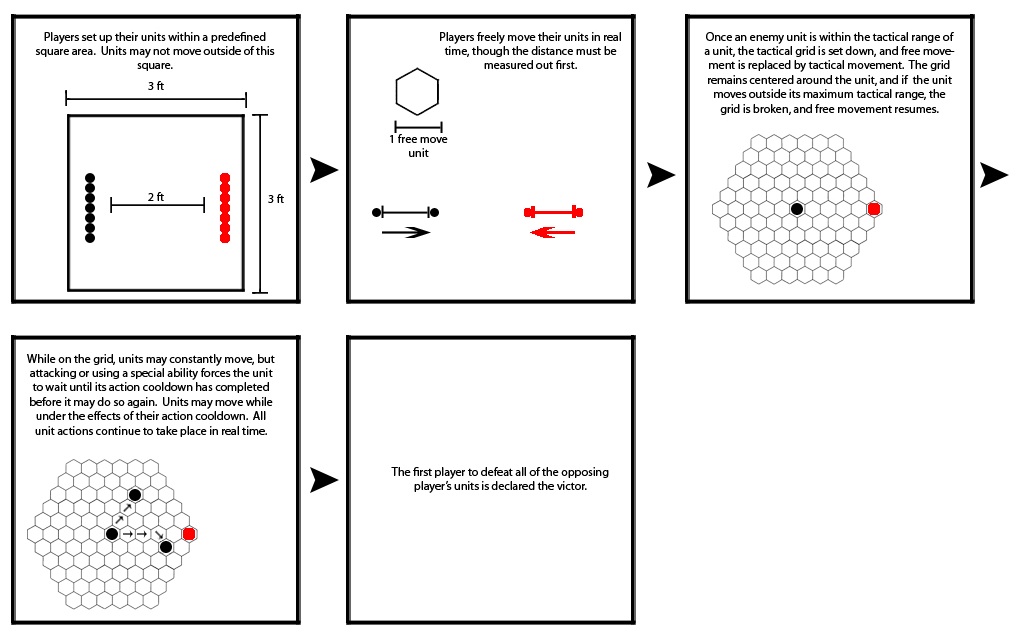
This project was created for Junior Year’s Game Systems and Experience Design class. The principle behind this system was to attempt to marry large scale strategic play seen in games such as Starcraft or Age of Empires, with the precise tactical gameplay of games such as Final Fantasy Tactics or Fire Emblem. Though the system is not designed for the sheer number of troops often seen in Starcraft games, a well-designed and responsive interface and controls would allow players to easily control larger number of units. Essentially, the system revolves around the concepts of ‘free-space’–RTS-style rules and movements–and ‘grid-space’–turn-based tactics rules and movement. Overall troop management is controlled via ‘free-space’ rules, but when a unit is within a certain distance of an opposing unit, ‘grid-space’ rules apply. The full system can be seen below.
History and Intent
Many of the most popular Real Time Strategy games of the current day, such as the Starcraft, Warcraft, Age of Empires, and Command and Conquer series, are very largely focused on the strategic aspects of battle: large scale affronts, overarching goals, and diplomacy.(1) The tactical side of battle within RTS’s, showcased in games such as Final Fantasy Tactics and Fire Emblem, is often given less focus, as some of the most specific aspects of battle, such as precise movement and targeting, are automated, likely due to the games’ large scale.(3) As such, the goal of this system is to provide to players a more tactical RTS experience: to allow them to have fine control over which each and every one of their units does. The intent of this system is to attempt to merge large scale strategic gameplay with that of precise tactical combat.
Description
- Units move freely between “Free-space” and “Grid-space”, based on their distance to enemy units
- “Free-space” movement and unit control is the same as a traditional RTS
- “Grid-space” allows single units to move and attack precise locations and units, similar to a turn based tactical game
It is important to note that this system would be intended for smaller scale strategy games, as opposed to the size of armies in games such as the Starcraft series.
Initially, unit control under this system would be similar to that of most RTS’, where units are able to move and path freely through the environment to reach their destinations. However, once a unit comes within a certain distance of an enemy unit, a grid is placed around the attacking unit, equal in size to the unit’s combined attack and movement ranges. While in grid space, units and their abilities are controlled in a manner similar to those of Turn-Based Tactics games–upon taking a movement or active action, units must wait for a short cooldown period, respective to the type of action, to elapse before being able to perform that type of action again. Units move to specific spaces, and target abilities and attacks relative to specific unit or grid spaces. If the distance between a unit and enemy units ever becomes greater than the threshold distance required for grid space, that unit returns to free RTS-style movement and actions.
It is important to note, that only units within grid space operate according to grid space rules, just as only units within free space operate according to free space rules. Additionally, units can freely move between space types. This means that, if a unit moves into grid space against another unit, reinforcements on either side can move according to free space rules, until they enter the distance threshold required for grid space, at which time they begin to operate according to grid space rules.
Bibliography
1. Berlinger, Yehuda. “Puerto Rico Strategy vs Tactics.” Blogspot.com. Blogspot, 10 Feb. 2005. Web. 9 Oct. 2011.
2. changegames. Starcraft 2 Battle Tactics – 2v2 Protoss vs Terran (ePic Games & eSports). Youtube video. Youtube.com. Web. 9 Oct. 2011. <http://www.youtube.com/watch?v=i7QdqVLtu8I>.
3. Gleichman. “Strategy and Tactics in Game Design- Part I: Introduction.” Blogspot.com. Blogspot, 12 Feb. 2009. Web. 9 Oct. 2011.

 Jacob Mott