Full Metal Tactics was originally a mech-themed MOBA, which was later repurposed and combined with a turn-based strategy concept to become to become FMT as it is today.
The original MOBA shared many characteristics with FMT, as well as a number of its own unique features, including:
- Customization: Alter the mech’s base stats, select the mech’s five “skills”, and choose from a variety of functional and aesthetic appearance customizations.
- Leveling: Each skill has multiple upgrade paths, which can be bought during matches.
- Persistent Account: Collect parts and blueprints to craft mech pieces and skills.
- Gameplay: Wardens and Kings take the place of towers and bases as mobile boss-style units. Refueling stations scattered through the map restore ammo for abilities and mech health.
- Map Design: Standard lanes and jungle areas, though objectives exist in both that can affect the other.
Customization:
- Players create their mech’s kit by selecting four skills
- Skills focus on actions, rather than passive bonuses
- When it comes to appearance, form does not influence function, except weight and size
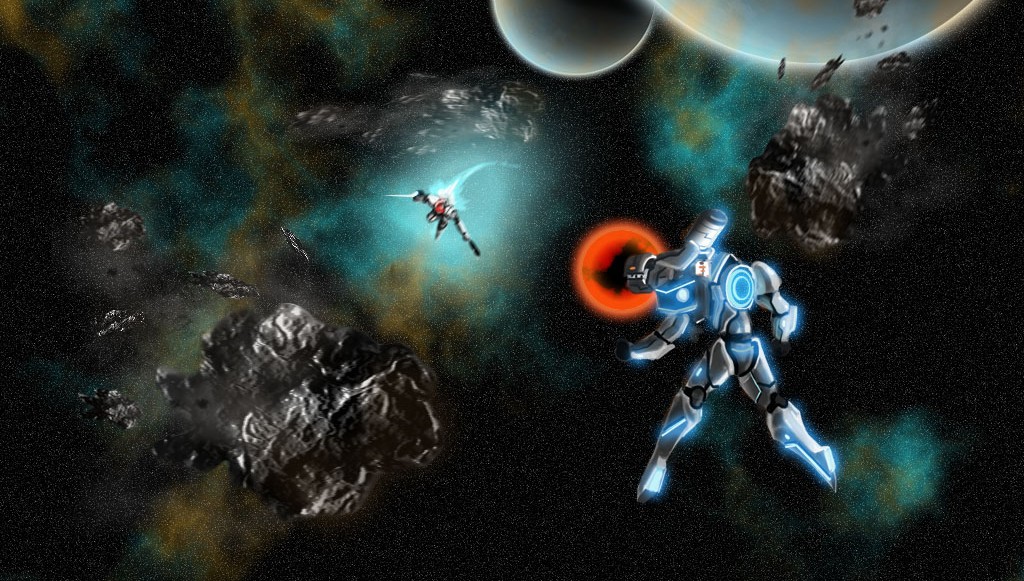
Just like in Full Metal Tactics, customization is a central aspect in the Mech MOBA. Mech “skills” are essentially the weapons they posses, and in some cases it was possible that the same weapon might appear in different skill forms, or even take up two skill slots, depending on its size and power. In either case, the focus of these skills were on actions–abilities that would result in a passive or non-interactive benefit were, except in the case of weapons that filled two skill slots–largely non-existent.
It was when we were first creating the Mech MOBA, that we realized that, given how key customization was to the experience, we never wanted players to have to choose between a chassis that looked really cool, and a chassis that had better stats. We did away with form affecting function when it came to customizing the appearance of the mech, with two exceptions: size–which usually only influenced skillshot targeting–and weight–which would influence how mechs interact with weight dependent aspects of the map, such as pressure plates or bridges.
Full Metal Tactics inherited the Mech MOBA’s customization rules, with weight being the only exception that did not carry over.
Leveling:
- Each skill has upgrade paths which can be purchased
- Upgrades change the strengths and weaknesses of the skill
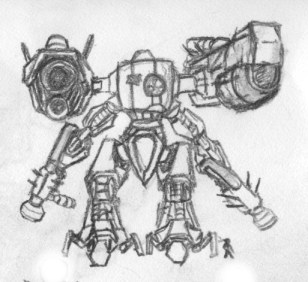 When it came to deciding how mechs should increase in power over the course of a match, we eliminated the traditional route of gaining levels–in part because it didn’t make sense within the game’s universe, but also in an attempt to place more emphasis on skill, rather than sheer numerical advantage. Instead, each skill has a number of upgrade paths, which can be bought using parts–a resource dropped by slain units–that influence how the skill functions. For example, an upgrade for a missile barrage skill might increase the size of its AoE but decrease its maximum ammo, while another might increase its damage but increase its cooldown period.
As Full Metal Tactics took place on a much smaller scale and lacked AI units to gain resources from, it took none of the Mech MOBA’s leveling systems.
Persistent Account:
- Holds parts, pieces, skills, and blueprints
Unlike skill upgrades, which do not carry over between matches, the persistent account stores mech pieces, skills, blueprints, and parts. Parts, gained at the end of every match, are used in conjunction with blueprints to unlock pieces and skills. In addition, non-players units have a chance of dropping blueprints, parts, and pieces, which are visible to, and able to be grabbed by, all players of all teams.
Though all weapons and aesthetic customizations would be available to players from the beginning in Full Metal Tactics, it did inherit part of the persistent account, in that created mechs would be saved to the player’s device.
Gameplay:
- Wardens and Kings replace towers and bases, respectively
- Wardens and Kings are mobile within a small area
- Wardens and Kings are boss fights against powerful AI controlled mechs
- Health and skill ammunition can only be restored at refueling stations throughout the map
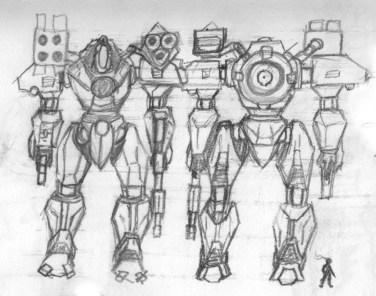 We wanted to keep players always interacting with one another and fighting for survival, and decided to remove any health restoring items, as well as base skills on ammunition. Refueling stations are plentiful with the Mech MOBA, but not always immediately within reach. If players want to repair and rearm their mech, they must make sure their team has secured a nearby refueling station.
Likewise, we wanted players to have more interaction with the non-player controlled barriers (towers) between bases, and thus created Wardens and Kings. Wardens patrol a small area, and attack an enemy units within–now, a battle within a Warden’s influence becomes more like a boss fight against powerful mech. Kings are essentially the same a Wardens, though much more powerful. They take the place of the final base, and require an entire team effort to overcome.
Full Metal Tactics took a smattering of concepts from the gameplay of the Mech MOBA. Refueling stations were reduced to only being present on the team or player spawn, while Wardens and Kings were eliminated in favor of placing more emphasis on player to player interaction.
Map Design:
- Objectives in lanes and jungle influence one another
- Weight influences how mechs interact with some pieces of the environment
Rather than separate lanes and jungle as two separate spaces, unique objectives are present in each that influence the other. For example, a power generator located in the jungle might decrease the power of a nearby Warden, while a pressure plate in a lane might lower a wall in the jungle. Additionally, certain pieces of the map can be approached differently depending on the weight of the mech. For example, a heavy mech might be capable of activating a pressure plate or collapsing a wooden bridge, while a lighter mech would be able to navigate through delicate terrain pieces or pass through movement impairing areas.
As with gameplay, Full Metal Tactics took only parts of the Mech MOBA’s map design. The concept of lanes and jungle were eliminated in favor of arena style setups, again in order to emphasize constant player to player interaction. Map objectives made the jump, however, in the form of generators which if destroyed would lower doors or cover, granting easier access to additional objectives or enemy players.

 Jacob Mott