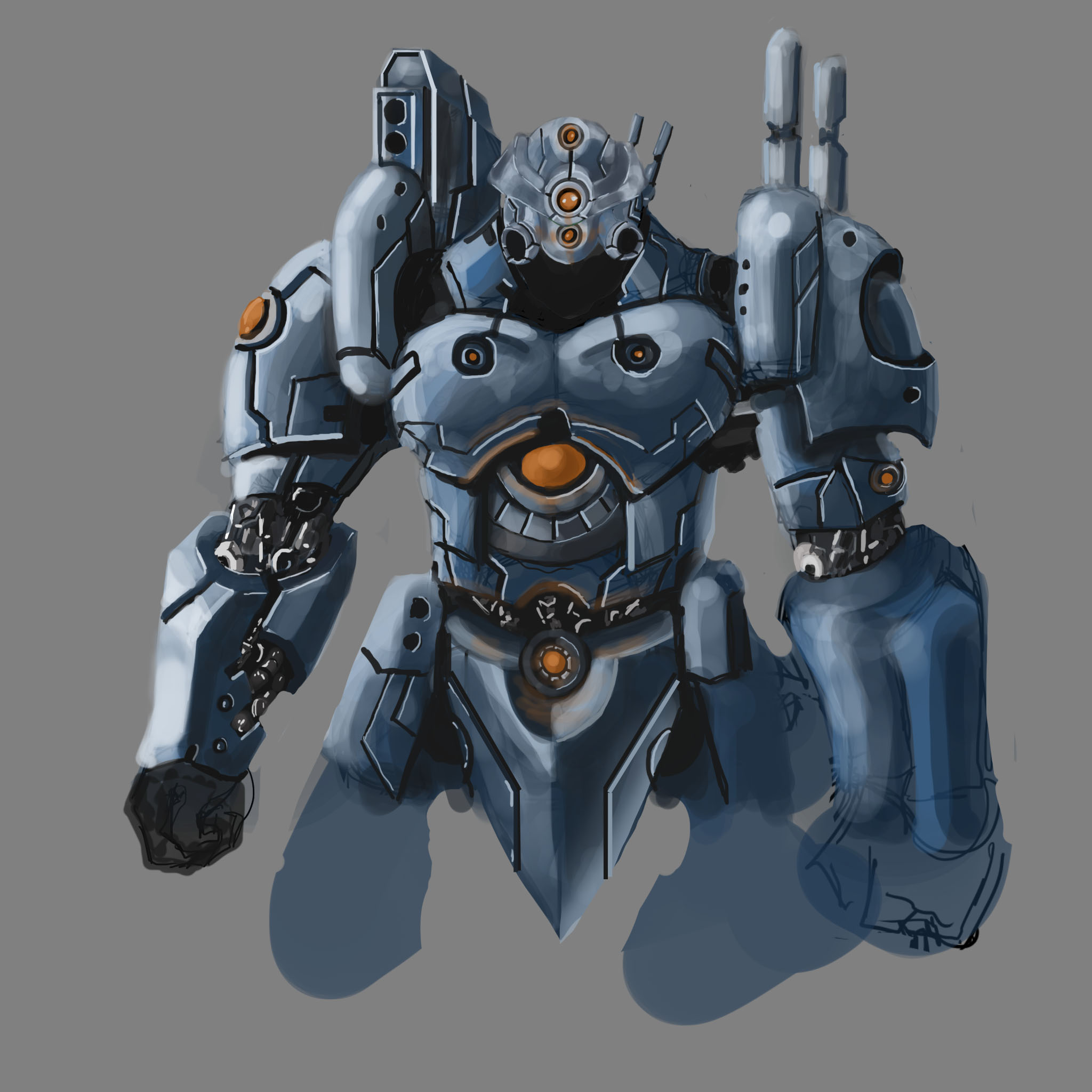
Full Metal Tactics is a multiplayer turn-based strategy, tabletop style game created in Unity 3.5 and intended for tablet devices. The game was a group project created for senior year’s Senior Capstone in Game Development class, but was not selected for Senior Production. Players are able to create the mech they’ve always wanted, customizing first its base stats, and then its arsenal of weapons, before jumping into the battlefield to destroy their enemies.
What to play the original paper version?
You can find the rules here.
As well as a sample map here.
Jump to a Section
Project Details:
Team Size: 4 Project Duration: 4 months (September 2012 – December 2012)
Engine: Unity 3.5
Team Members:
Martin Cuadra – Lead Artist
Ryan Hill – Designer
Justin Ryder – Lead Programmer
My Roles:
Systems designer, Gameplay Designer, Prototyper, QA Analyst and Manager, General Scripter
The History of Full Metal Tactics:
Full Metal Tactics was originally a mech-themed MOBA. The original concept, and how it evolved to become Full Metal Tactics it is today, can be viewed here.
Customization:
- Alter base stats
- Select four weapons and one Uber Ability
- Aesthetic customization does not influence function
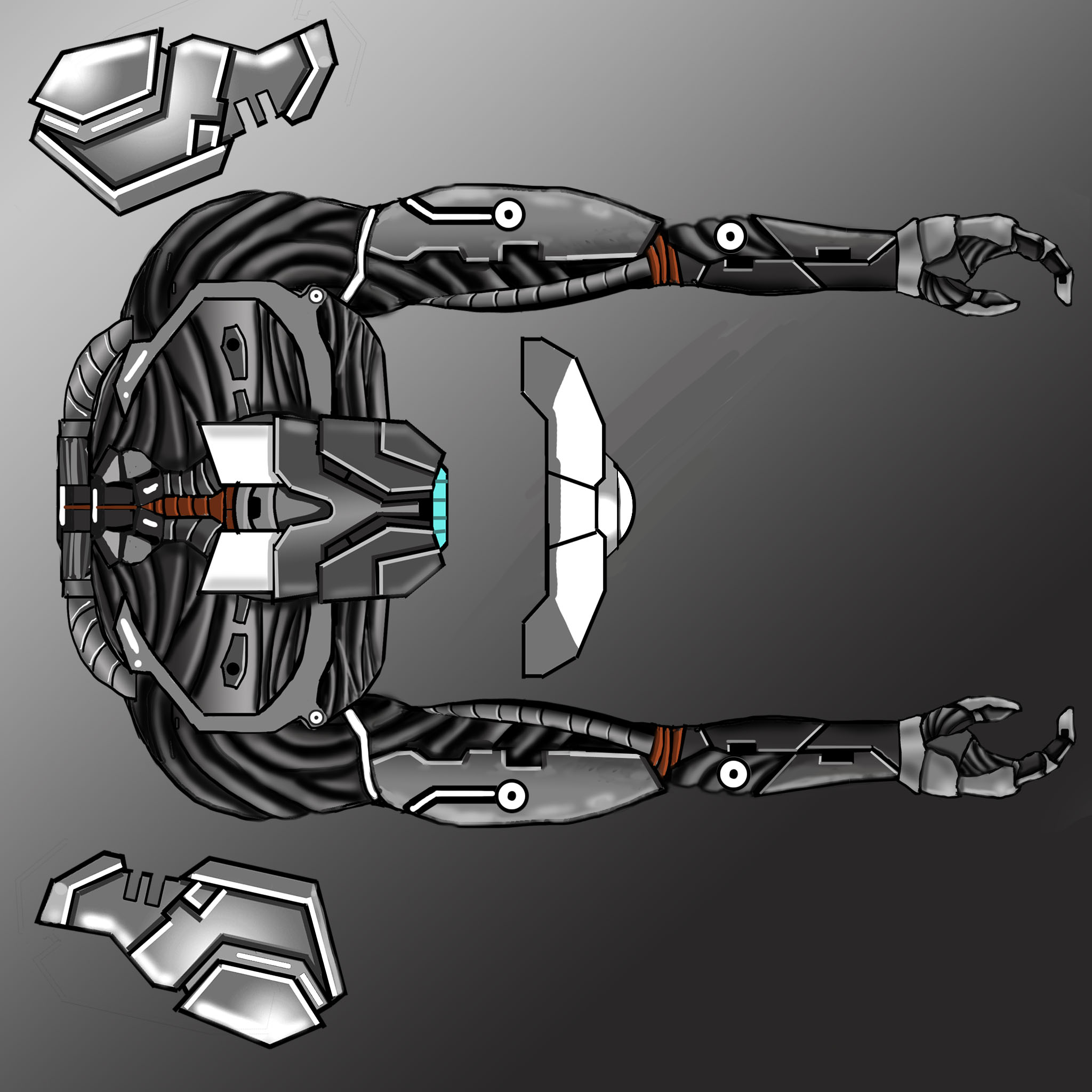
One of the most important guiding principles behind FMT is that players be able to create the mech they’ve always wanted, and that these mechs be unique and as capable as possible in whatever role the player desire. Players begin the framework for their mech by customizing its basic stats. These stats are intended to be fairly straightforward and easy to understand, so that player’s could quickly begin to see their mech taking form–tanks would put their points into Health, Energy Resistance and Ballistic Resistance, while strikers would focus on Mobility and Loadout. Next, players move on to weapons, which truly define how their mech performs, before finally, in the end product, customizing their mech’s aesthetics from a wide variety of options. For example, players might be able to select from model changes, texture details and effects, and weapon VFX. Early on, the choice was made to separate aesthetic customization from functional customization–we wanted players to be able to create the mech of their dreams, and not be forced into a choice because it contained a functionality they wanted.
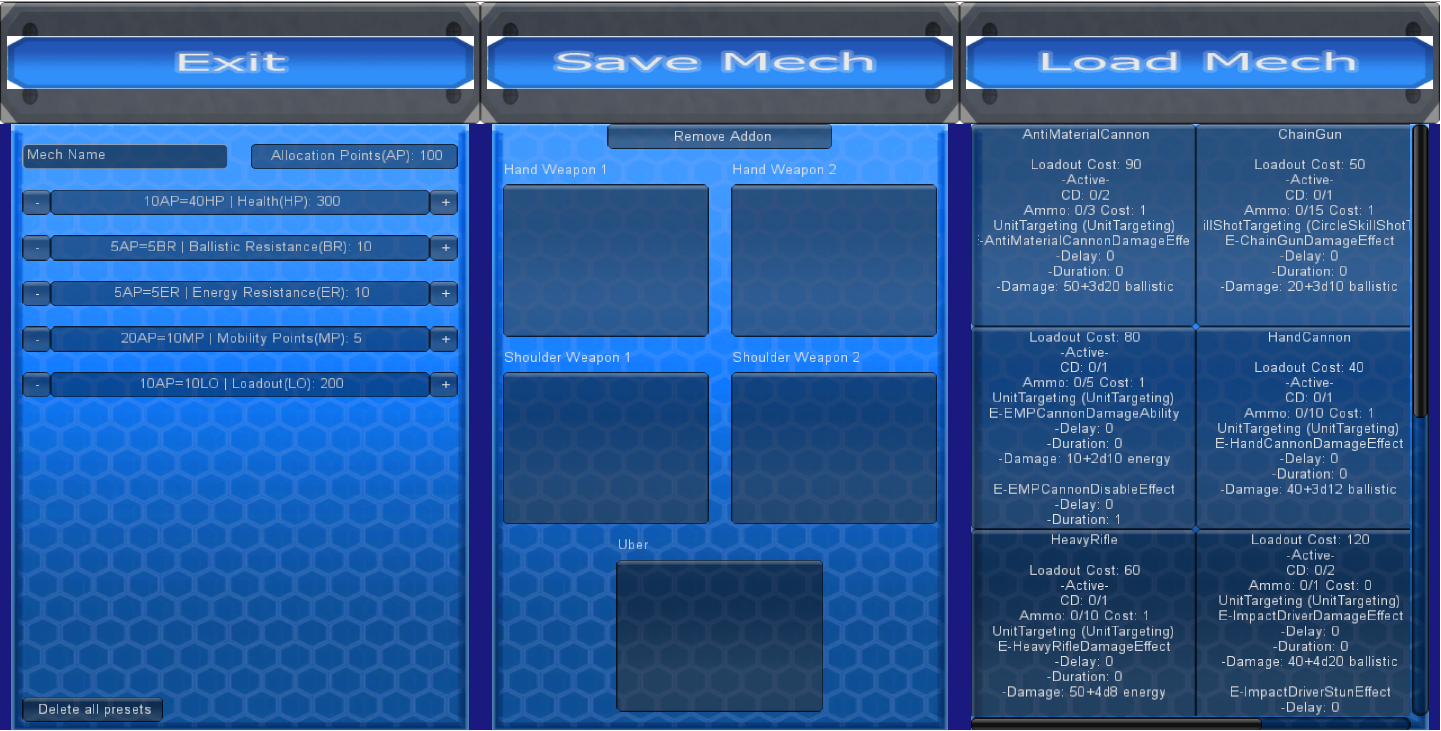
The initial customization screen…
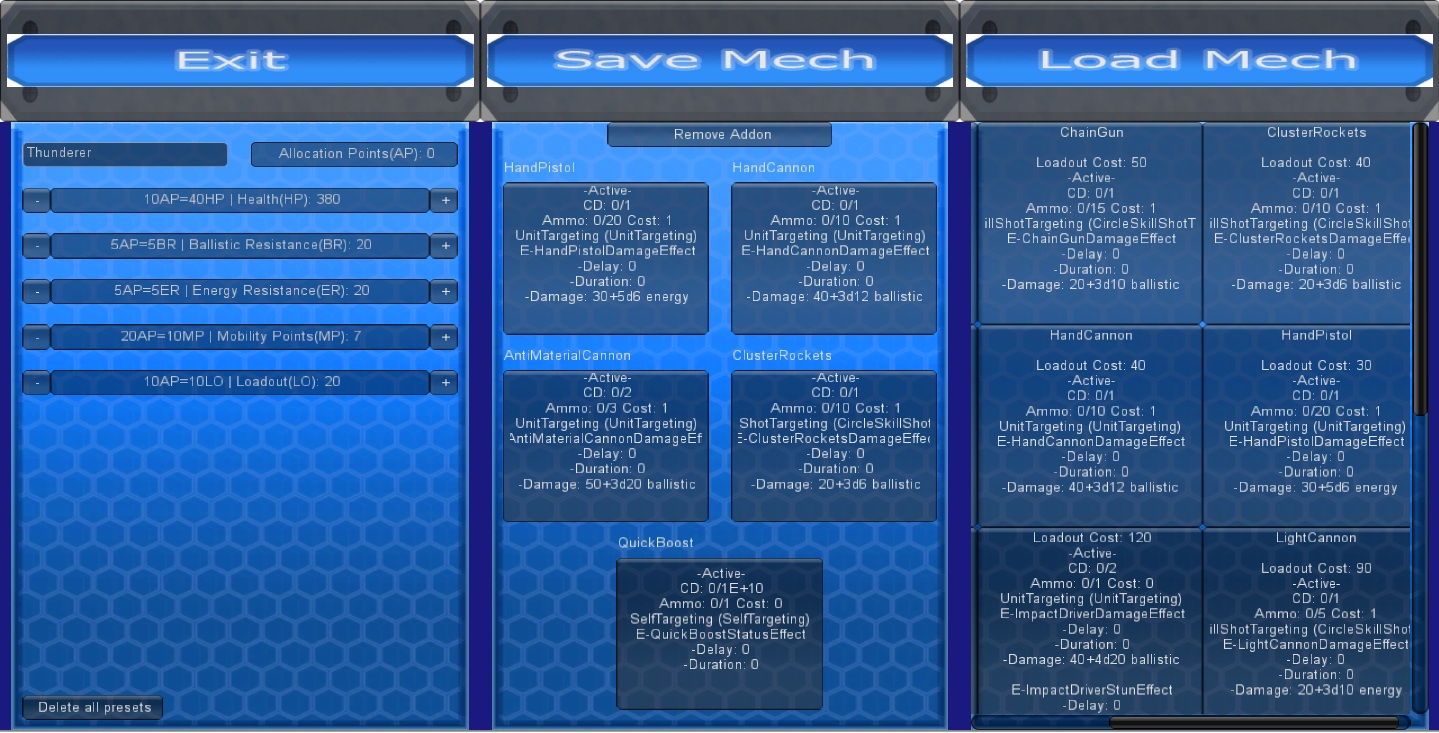
…and a fully customized mech…

…and finally the mech in-game.
Weapons:
- Weapons act as skills and define a mech’s function
- Weapons are balanced based on the possibilities their abilities create
- Abilities can inflict effects, deal additional damage, or have special targeting types
Weapons are where the functionality of player’s mechs truly became apparent. Though weapons come in a variety of stat forms, they all have either a special ability or rules to go along with them. Additionally, while some weapons are comparatively standard and come in stat varying flavors, others are crazy and playstyle defining. For example, the LRE Cannon, with slightly above average stats across the board, and the Hotshot ability–which slightly increased damage if the target was at the end of the weapon’s range–are fairly standard and often used weapons on a variety of mech types. Backdraft, however, was a very rarely used, but specific, weapon, designed more for brawler mechs who want to disrupt groups of enemies. A melee weapon with fairly high damage, Backdraft’s special ability, in addition to its regular damage, causes half of that damage to be dealt to the player, and the other half to be dealt in a cone behind the player.
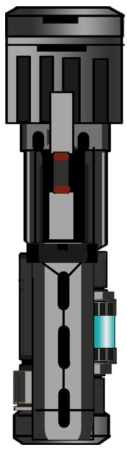
- Weapons have abilities that open up new gameplay opportunities, as well as influence their range, targeting type, the way they deal damage
Special abilities were a key component when it came to balancing the weapons. Longer range weapons are innately more powerful, as they would allow players to attack with little fear of retaliation, especially on mechs with high mobility–likewise, a weapon with an AoE attack type would not only have greater range, but be capable of a higher relative damage output when used against multiple targets. As weapons deal a total of base and random damage, it was important to take into consideration abilities that could inflict one of these styles of damage. Take for example, a weapon that deals 40 base damage plus 3d20 random damage (meaning it deals 3 to 60 damage, which is then added to the base damage). If the weapon has an ability that deals its base damage twice, it will on average, be more powerful than if its random damage is rolled twice. However, in the case of the latter, it does have a chance of greatly out-damaging the former, and its power level must reflect this understanding.
- Weapons can inflict status effects, such as slowing movement, or disabling weapons
Additionally, some weapon abilities can inflict special statuses upon mechs, such as reducing the number of actions they can take in a round, or tethering them to a place or another mech. It then became important to balance the power level of a weapon against the possibilities its ability opened up. For example, while an ability that stuns its target for one round seems fairly benign, this would allow one mech to entirely lock down another until the weapon ran out of ammo, or, more likely, the target was destroyed. Rather than reduce the weapon’s ammo to such an extent that it becomes a one-shot-wonder, one method we used was to simply increase the cooldown of the weapon to two, rather than one, rounds before it could be used again.

‘Uber-Abilities’ are another key aspect of a mech’s capabilities, as these abilities, only useable once per life, can have dramatic effects on gameplay. For example, System Shock causes all opposing player’s actions to have a chance of failing for one round, while Lightning Reflexes is capable of immediately granting a player one action of any type.
Player Experience:
- Styled after tabletop board games
- Passing the tablet device keeps players physically interacting with each other
- Tablet device can be connected to larger screen via HDMI, granting all players visibility of gameplay
FMT is to be a tabletop style experience that is designed to make you love or hate your friends–we want players to be interacting with each other just as much as they would be with the game. Initially, we decided that having players pass the tablet device amongst one another would accomplish this task nicely, as players would have to physically interact with one another. However, we quickly came to realize that given such a situation, whichever players were not currently using the device would not only be unaware of what was occurring during the turns between theirs, but would also not be sharing in the experience. To remedy this, we decided the game would have the recommended option of connecting to a larger video device via HDMI. Players still pass the device between each other, but are now also are aware of what is occurring at all times, and are sharing in the experience.

 Jacob Mott