Sagittarii Run is a four player racing arcade game, currently being developed for senior year’s Senior Production class. Players compete across a variety of locales set near the black hole Sagittarii V4641, and must contend with the effects of rampant gravity and rifts to another dimension.
Project Details:
Team Size: 12 Total Duration: 8 months (Sept. 2012 – Dec. 2012, Jan. 2013 – Apr. 2013)
Engine: Unity 4 My Duration: 4 months (Jan. 2013 – Apr. 2013)
Team Members:
Jason Rauck – Project lead, lead designer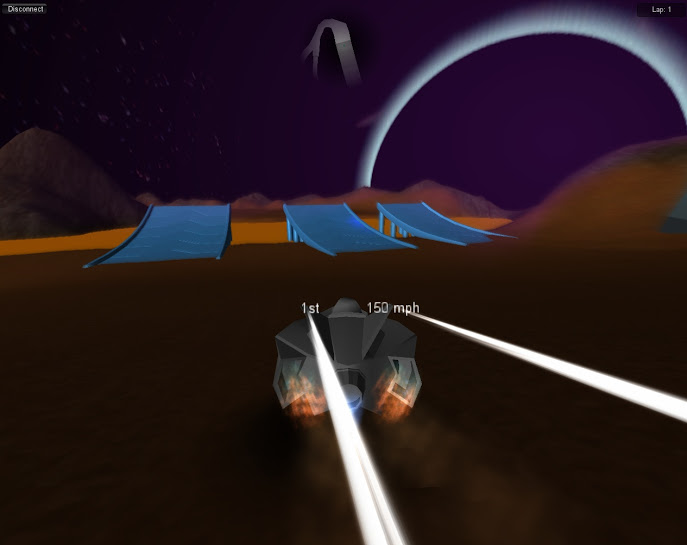
Grant Parker – Project lead, lead designer
Matt Ide – Project lead, lead artist
Chris Brough – Project lead, lead programmer
Ethan Akey – Producer
William Dramstad – Lead designer
James Harvey – QA lead
Justin Ryder – Programmer
Kyle Marchev – Programmer
Josh Stowe – Artist
Eric Miles – Artist
My Roles:
System and Experience Design – Currently working on the logic and formulas for rifts–a rubber-banding and speed boost system–the experience of piloting the hovercar, the spectacles that populate the race–such as collapsing buildings and crashing ships–and the experience of the game as a whole.
Jump to a Section
Rifts:
Though rifts are implemented in multiple systems, the do have common characteristics.
- Rifts can be grabbed by any player
- Rift drag-races are divided into four sections, each more challenging than the last
- Rifts are more difficult the higher your place. For example, a rift for the player in second place is more difficult than a rift for the player in fourth place
- Hitting an obstacle or falling off a section returns the player to a point on the track that corresponds to the start of the current section
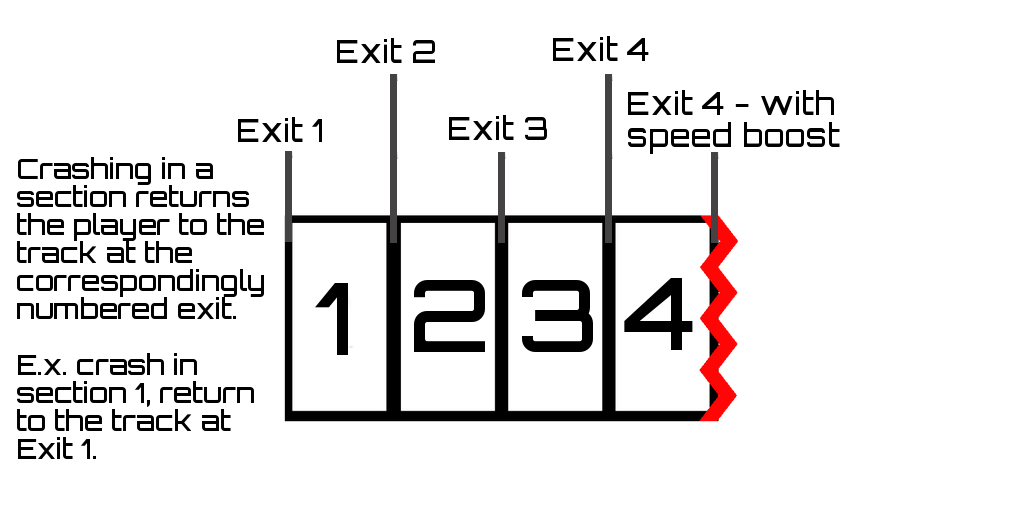
The layout of a rift
The ‘Necessary Rift’ System:
- Acts as a rubberbanding mechanic to keep all players competing together
The main purpose of the Necessary Rift System is to rubber-band players, keeping them all competing together. As the game is intended for arcades players will be of all ages and skill levels, the experience could very easily be ruined if the best players are constantly alone out in front, while the worst players are alone in the far back. The system works by first checking the distances between each player–if this distance is greater than a track-dependent threshold, the player is placed in consideration for a rift. The player with the greatest distance is then granted a rift, the exit of which is tethered to the player directly ahead of them. The rift itself is an intense six-second drag race, where players must avoid obstacles to progress. The further the player makes it through the rift, the closer they will exit to the player ahead. If they make it all the way through the rift, they return to the track with a short-duration speed boost at the waypoint the ahead player most recently passed.
- Game measures the distances between the player and the player directly ahead
- If the distance from step 1 is greater than a track-dependent threshold, the player whose distance is being measured is placed in consideration for a rift
- The player with the greatest distance from step 2 is granted a rift, which spawns a short distance ahead of them.
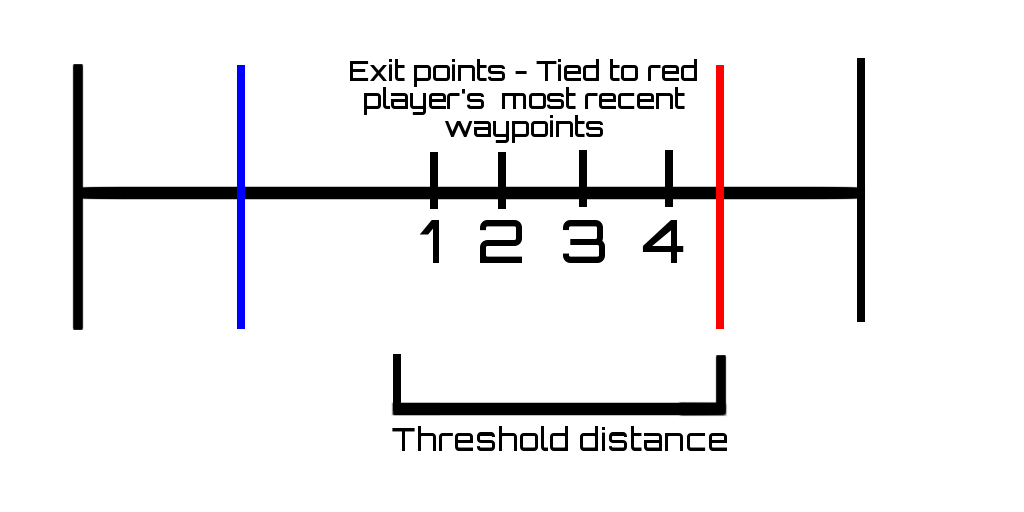
- The rift is divided into four sections, each of which correlate to an exit point on the track, based on the waypoints the player ahead most recently passed
- Upon hitting an obstacle, falling off the section, or reaching the end, the player returns to the track at the corresponding exit point. If the player made it all the way to the end, they exit with a speed boost.
In the picture below, the blue player is outside the distance threshold, and will be considered for a rift. Their exit points are tethered too the red player.
The ‘Unnecessary Rift’ System:
- Acts as a short speed boost
- Designed to create some chaos in tight groups of players
Unlike the Necessary Rift System, the purpose of the Unnecessary Rift System is to throw a wrench in a pack of players that have been in close proximity for too long. The Unnecessary Rift System acts more like a power-up, granting a random player access to a rift, which transports them forward a short distance. If all players are within a track-dependent distance for a track-dependent amount of time, a rift is created for a random player based on their place in the race. The player in first has a 10% chance of being granted a rift, while second place has a 20% chance, third has a 30% chance, and fourth has a 40% chance. Any player can grab a rift, and in the case of unnecessary rifts, a rift being granted to a player simply means that it is directly in their path, and they are most likely to grab it.
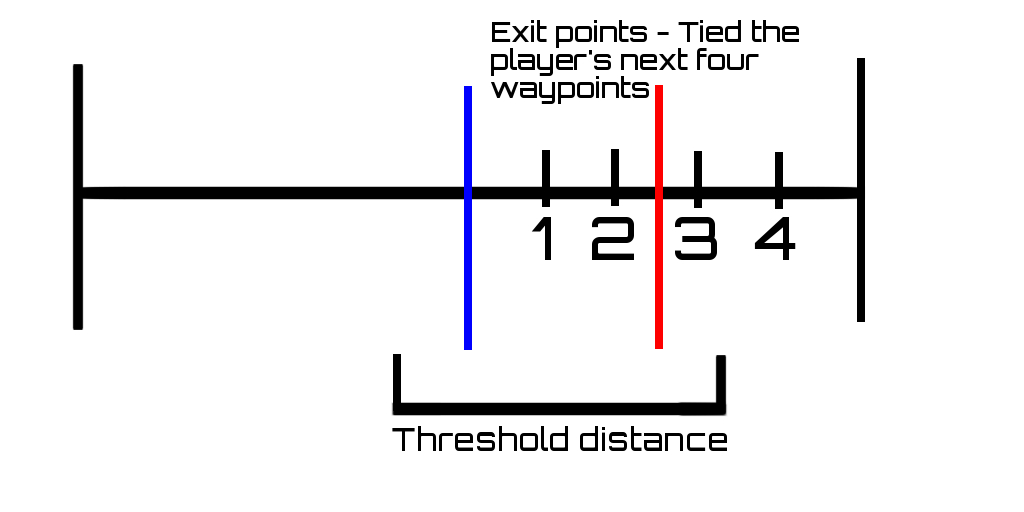
The exit points of Unnecessary Rifts are static, and simply correspond to the four waypoints ahead of the player when they enter the rift. As with Necessary Rifts, if the player makes it all the way to the end of the rift, they return to the track with a short-duration speed boost.
- The game measures the distances between all players
- While all measurements from step 1 are within a track-dependent threshold, the game does a time check.
- If the time check from step 2 is greater than a track-dependent threshold, a rift will be spawned, intended for a random player
- The exit points correspond to the next four waypoints ahead of the player. If the player reaches the end of the rift, they return to the track with a speed boost
The below picture diagrams the Unnecessary Rift System, with the blue player being the player who has received the rift.
Spectacles:
Spectacles are what make each track unique in Sagittarii Run. In some cases, spectacles are simply eye candy. In others, they are a critical part of the track that defines the experience as a whole. When we first started drafting spectacles, we began by looking at theme park rides at Disney World and similar locales, and realized that it would be more effective to define a vocabulary for the types of spectacles we would be using.
In addition, we laid a few ground rules that would apply to all spectacles:
Nothing Stops Moving – If something crashes into the ground, it should emit sparks, smoke, or teeter for the duration of the race. Anything that stops is dead.
In most cases, a large number of people should see a spectacle – Spectacles are big, awesome, and should never be a single-player-only experience.
Spectacles Defined:
Static: These are objects that do not move or perform simple animations, such as a sign or crashed ship parts
Repeating: An event that occurs every X period of time, such as a ship flyover
Centerpiece: The big, amazing feature that defines the track, such as ghost-spaceship battle
Triggerable: An event that occurs as a result of a player’s action, such as a pressure plate that opens a shortcut
One Shot: An event that occurs once, and then turns into either a static or repeating spectacle. An example would be a crashing ship
Single Use Path: A path that can only be used once, such as a collapsible track section
Fake Obstacle: An obstacle that appears to be an obstacle, but is in fact the intended path. For example, a building that falls on its side and is then driven up by players
Easter Egg: A humorous event, such as a cow floating through space
Faux-Spectacle: A spectacle that appears to be hazardous to players, but is in fact not. For example, a lazer cannon that shoots at players, but will never actually hit or cause damage

 Jacob Mott