How is a Boss Built?
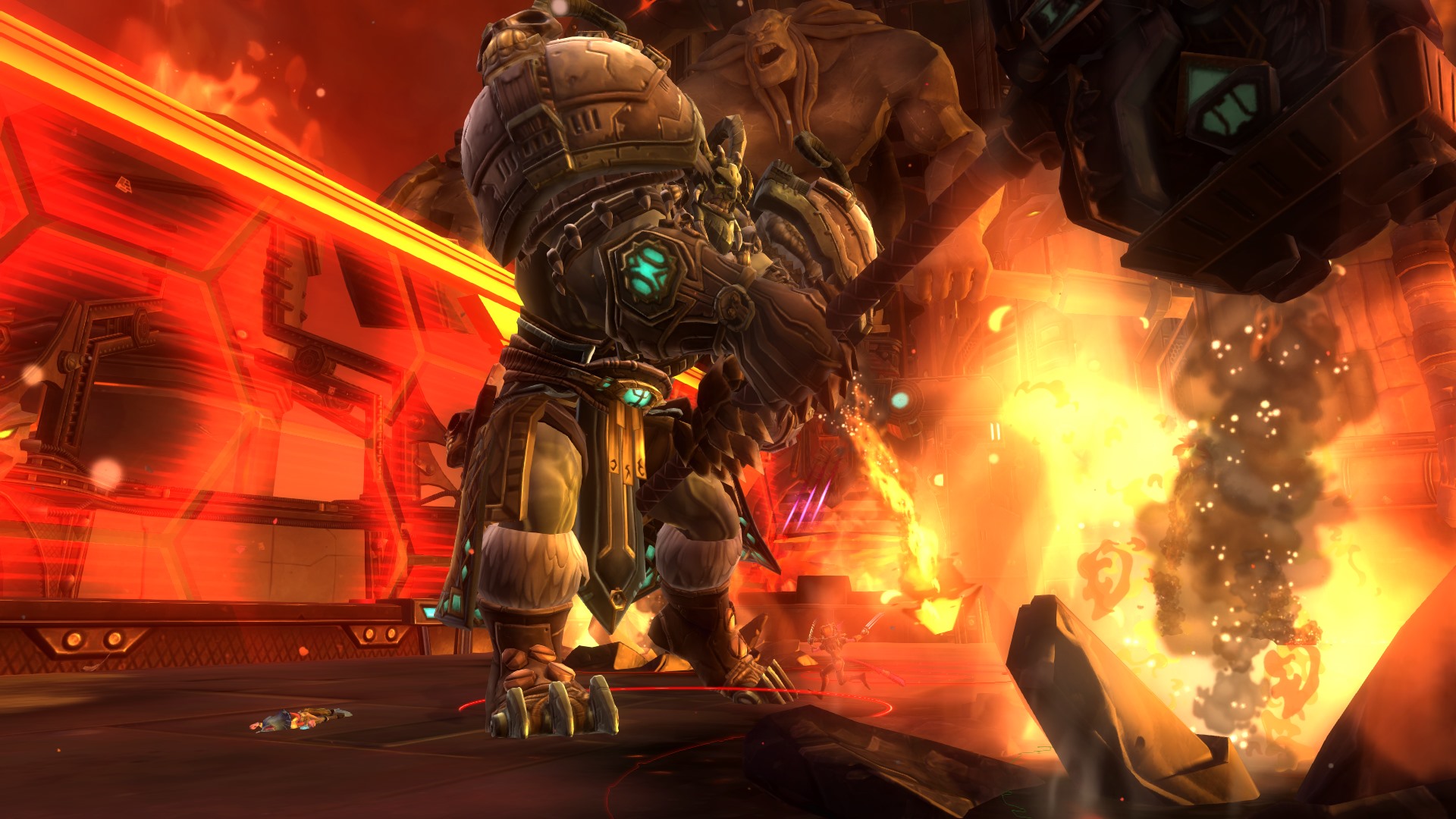
Bosses and events come in many shapes and sizes, and while this process can vary and might not be used in every situation, this is typically how I approached building fights for Wildstar’s dungeons and raids. It’s important to note that this is just a general guideline. Depending on the state and goals of the fight, steps may be skipped, or performed out of order.
1) Inspiration:
The first step of building a fight typically starts with the inspiration. These are things the boss should or might do, how their environment might be structured, or ways their fight structured overall. These inspirations typically come from narrative, lore, and the way the boss fits into the world, but can just as easily come from design or art directions. For example, in the case of Ohmna, her dreadphage form saw her become fused with the core chambers of the Genetic Archives. While we originally had some concepts of her swimming through the arena (as her model is worm-like in appearance) we ultimately decided that the main section of her body should stay anchored in the center of the arena as it would better focus the players’ attentions, and reinforce that the entire environment is Ohmna and her domain, rather than just being an monstrosity that happens to inhabit this particular area.
2) Goals and Intentions:
Once some bit of inspirational groundwork has been laid, the next step that takes place is typically design and prototyping. However, for my own design process, the Goals and Intentions step comes next, and is one of the most critical. In this step I begin to outline some of the skills I want to test players on, to give them opportunities to improve themselves, and set the bar for performance.
These can be simple goals, and often in this early stage are very loose and conceptual, such as training reaction time, which will might result in abilities with quick cast times or random positionings, such as veteran Tugga’s Molten Rain, or training movement in constrained spaces, which will might result in area denial fields or wide radius attacks, such as Bev-O-Rage’s Tri-burst telegraph that accompanies its auto-attacks.
This can also be more complex, such as training the group’s communication skills, which might result in forcing the group to focus on multiple objectives simultaneously, or completely separating groups from the influence of other group mates, while having them tackle challenges that influence one or both groups, such as the lower generator rooms of the System Daemons. Minibosses and basepop may focus on as little as one skill, while more extensive bosses will test players on up to all their skills, at various intensities.
3) Initial Design and Prototyping:
Design and prototyping has a tendency to occur from the very beginning, once the fight is assigned to be worked on, and will continue to apply throughout the entire process, though it is most prevalent in this step. After an initial brainstorming session, this step largely consists of a repeated cycle of: brainstorm and discuss ideas, prototype mechanics, test internally, analyze feedback, modify and alter mechanics, repeat. This continues until enough of the fight mechanics are in sufficiently readable and functional state that they can be tested by players.
Prototypes can be quite different from the ultimate end result—as an example, in the Prototentiary, the Drones used to be guard packs, that groups could either sneak by, or engage in combat. To reinforce the stealth emphasis of the event, the guards were changed to drones, which cannot be defeated, and gained unique behaviors, such as the ability to detain targets caught in its sight cone, pathing towards targets that hit it with attacks, and investigating gate guards when the MoO.
4) Iteration, PTR Push, and Polish:
This is another, if not the most, important step of the process. Here live players can test the fight on PTR servers, and a whole new slew of feedback will present itself. Pieces of the fight will break, bugs and exploits will be found, and mechanics that initially seemed interesting can turn out to be degenerative, boring, or completely opposite the directions of the fight as a whole. Player feedback and data will be analyzed, mechanics will be tweaked, iterated, and reworked, bugs will be fixed, and mechanics will be cut or added.
This step will also be concerned with all the nitty-gritty polish—things like additional buff icons or story panels for readability, adjusting the timings on animations and vfx, or manually rotating the player’s camera after a teleport so they can clearly see their objective. This loop will continue until the fight meets the team’s and, most importantly, the players’ levels of quality. After this point, once the fight is released, usually all that remains is addressing any new bugs or exploits that come up—though this isn’t to say mechanics will never be changed if a strong enough reason presents itself.
Boss: Malfunctioning Dynamo
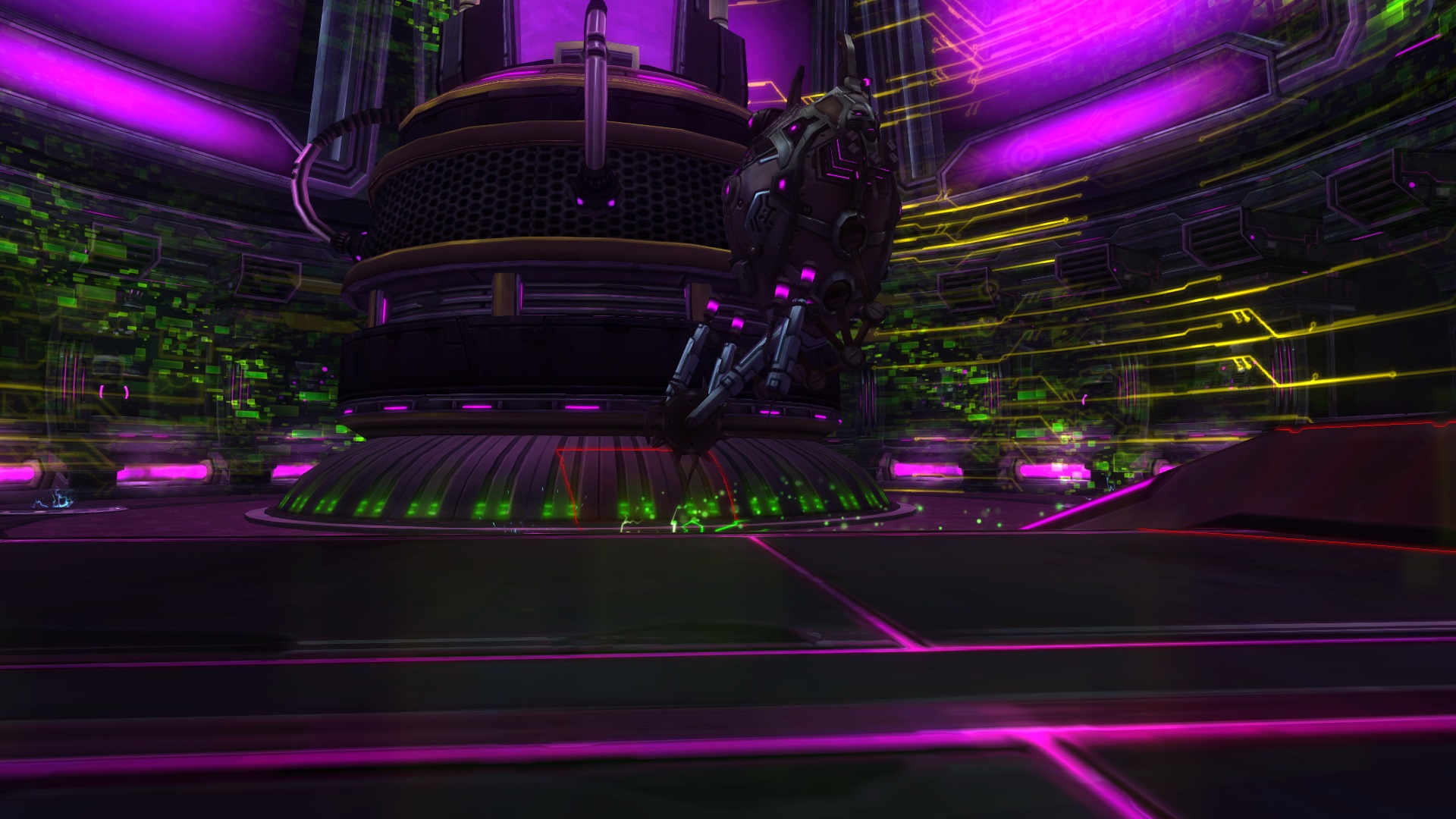 As an example of this design process, let’s take a look at the Malfunctioning Dynamo, one of a series of four minibosses that guard the entrance to Ohmna, the final boss of the Genetic Archives.
Inspirations:
- A dynamo that is spinning up, and when it reaches full power, it’s all over.
- This inspiration came from the pre-built space, which was a circular room with a pillar in the center—it seemed the perfect space where something would race around in laps, building up power.
Goals and Intentions:
- Ability usage on the move.
- Players must be constantly moving to keep up with the Dynamo, but must be aware of their positioning, as the Dynamo has a damaging aura beneath it. Additional hazards and objectives will spawn and move around the arena throughout the fight, forcing players to make increasingly calculated movements.
- Tank movement, communication, and ability usage.
- Tanks must be aware of the positioning of the other members of the raid, as they will need to pick up Static Charges as quickly as possible. Additionally, tanks must communicate between each other to make sure all tanks have an instance of the buff.
- Healer skill management and target prioritization.
- Healers must be aware of the health of their tank partners, while also being prepared to counter damage spikes and topping off DPS as necessary. The difficulty of the healers’ job also depends on the number of Static Charges group members have, as well as which players are charged—if only a single tank is charged, or a light armored player got charged, keeping that player alive can be very difficult.
- Spatial awareness, reaction, and avoidance.
- Live Wires rotate around the arena, with or against the direction the Dynamo paths, at varying speeds. Static Charges drop on random targets, but players must be sure that only tanks are the ones to pick them up.
Iterations:
Compared to most fights, the Dynamo had little in the ways of mechanical changes. A few alterations that do stand out, however:
- Static Charges now spawn at static intervals, rather than at check points.
- Static Charges now only last for a brief duration before despawning.
- A player can only have a single stack of Static Charge, though they are still able to pick up Static Charges.
- Originally, Static Charges persisted infinitely, and a single target could pick them all up, if desired (though this would likely result in their death). Another designer was working on some of the iterations for the Dynamo, and we decided to make these changes to further emphasize shared tank responsibility and reaction.
- Live Wires now spawn every two checkpoints once the Dynamo completes its first lap.
- Originally, a Live Wire was only spawned when the Dynamo completed a lap. The team really liked the gameplay the Live Wires created, but thought they spawned a bit too slow. As such, the spawn rate was increased.
Fight Breakdown:
The Malfunctioning Dynamo is always pathing around in a circle. It ignores threat of any kind, but is vulnerable to CCs if its interrupt armor is broken. Equally spaced around the circle are checkpoints, which serve to display to the raid the progress of the Dynamo on its laps. Once the Dynamo passes the first two checkpoints, it begins spawning Static Charges on intervals, and activates Arc-Thrower, an auto-attack that strikes five random targets, prioritizing those with Static Charges.
Tanks must pick up these charges before they expire, because when the Dynamo completes a lap around the circle, it casts Static Discharge, which either deals raid wide damage, or heavily damages a single target with a Static Charge. If a non-tank gets hit by a Static Discharge, it will likely result in a death. Additionally after the Dynamo completes the first lap, and every two checkpoints thereafter, a Live Wire is spawned, which similarly paths in a circle, damaging anyone that comes in contact with it. With each lap the Dynamo’s movement speed increases, and after five laps, it casts a spell that will wipe the raid in a matter of seconds.
Mechanic Breakdown:
- Direct Current: A line AE aura centered on the Dynamo that deals damage. Direct Current is always active.
- Direct Current forces players to be careful with their positioning. At the beginning, players must simply be aware of not accidentally walking into the aura while chasing the Dynamo. However, once Live Wires begin to spawn and the Dynamo speeds up, players must be careful not to trap themselves between two damaging auras, as well as avoid accidentally jumping into the aura while attempting to keep up with the miniboss.
- Static Charge: A stationary small circular unit, which is consumed by the first unit that enters its telegraph.
- Static Charge is the raid’s means of controlling who the Dynamo targets, similar to threat. As it spawns on a random target, DPS must be careful to not consume the unit, while tanks must quickly pick up the unit before it despawns. Tanks must also be careful of their positioning, as a player can only have a single instance of the Static Charge buff, but are still able to consume the unit. Live Wires can also become problematic, as accidentally taking additional damage while attempting to pick up the charge will place additional stress on healers.
- Static Discharge: A multi phase spell that either deals raid wide damage or heavily damages a single target.
- Static Discharge is a test of the raid’s execution on each lap. A short cast four phase spell, on each phase Static Discharge will either deal raid wide damage, or single target damage to a player with Static Charge, prioritizing targets with charges over raid damage. However, whenever a player with Static Charge is damaged by the single target version of this spell, it removes their charge. As such, if there are not enough players with Static Charges to match the number of phases, the spell will defer to dealing damage to the entire raid.
- Live Wire: An arc shaped telegraph that rotates around the arena, dealing damage.
- Live Wires come in varying sizes and move either clockwise or counterclockwise at varying speeds.
- CC Vulnerability:
- By making the Dynamo vulnerable to CCs, groups can use slows and roots to slow down its progress around the arena as needed.
- Speed Increase: An increase to movement speed granted every time the Dynamo completes a lap around the arena.
- The Dynamo’s speed increase acts as a sort of soft enrage, increasing the difficulty for players to keep keep position to maintain DPS, as well as the difficulty of avoiding Live Wires, as players need to begin taking much more direct paths of travel.
- Arc Thrower: An auto-attack that occurs at static intervals, dealing damage to five random targets, though it prioritizes players with Static Charges.
- Arc Thrower acts as white damage, to give gameplay for healers. Additionally, it stresses tanks’ abilities to utilize defensive cooldowns, as Arc Thrower will always prioritize targets with Static Charge over random targets, dividing the damage among the charged players. This means that when there is only a single player with a Static Charge, Arc Thrower will deal damage to that target five times.

 Jacob Mott